Open-book exams have a reputation for being the easy option. No need to memorise dates, formulas, or quotes word-for-word, right? In practice, many students find the opposite is true: open-book exam preparation takes just as much planning as a closed-book test, and sometimes more, because the exam is designed to test whether you can apply your material quickly under pressure, not just recall it.
If you have an open-book or take-home exam coming up, here’s how to prepare so you’re not scrambling through your notes when the clock is running.
1. Understand What “Open-Book” Actually Tests
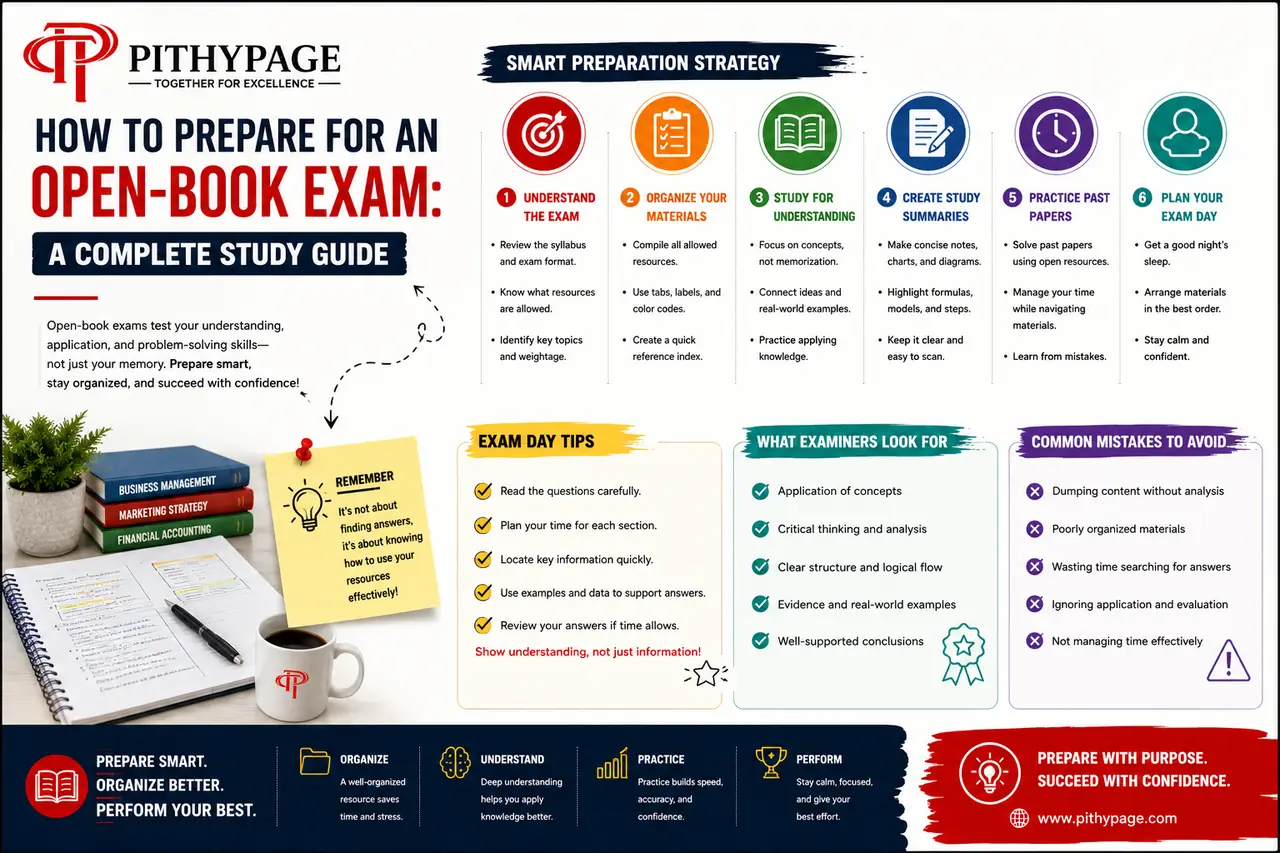
Instructors set open-book exams specifically because they want to see application, analysis, and argument – not transcription. That means the questions are usually built around scenarios, case studies, or “explain and justify” prompts rather than simple recall. Before you start reviewing material, read a past paper or sample question (if your course provides one) and notice the verbs used: analyse, evaluate, compare, justify. These tell you what kind of thinking the exam actually rewards.
2. Build a Navigable Reference System, Not a Second Textbook
The biggest time-waster in an open-book exam is flipping through a 300-page textbook looking for the one paragraph you need. Instead, build a condensed reference you can navigate in seconds:
- A one- or two-page summary sheet per topic, organised by the same headings your course uses
- A tabbed or colour-coded index in your textbook or notes for the sections you’re most likely to need
- A short list of key formulas, definitions, or case citations with page references, not full explanations
The goal is speed of retrieval, not completeness. If you can find the right page in under 20 seconds, your reference system is doing its job.
3. Practise Under Real Time Pressure
Open-book exams are almost always timed tightly relative to how much material you’re allowed to reference – that’s intentional. Run at least one full practice attempt using your actual notes and a timer, treating it exactly like exam day. This does two things: it shows you which parts of your reference system slow you down, and it builds the habit of writing a complete answer rather than an over-researched one.
4. Prepare Answer Frameworks, Not Answers
You won’t know the exact question in advance, but you usually know the topic areas. For each likely topic, prepare a short answer framework: the structure you’d use to answer any question on that theme (for example, definition → theory → application → evaluation → conclusion). Walking in with frameworks rather than pre-written answers keeps you flexible while still saving planning time on the day.
5. Check the Exam Format Logistics Early
If your open-book exam is delivered online – through a locked-down browser, a timed portal, or proctoring software – test the platform before exam day if you’re able to. Confirm what materials are actually permitted (some open-book exams restrict internet access to specific resources), how file submission works, and what your backup plan is if your connection drops. Sorting this out a day early removes one entire category of exam-day stress.
6. Manage Your Time Inside the Exam Itself
Once the exam starts, resist the urge to look everything up. A simple rule that works for most students: if you can recall the core idea without checking, write it and move on; only pause to verify a specific fact, figure, or citation. Skim-read the whole paper first, allocate your time per question based on marks available, and stick to it – a brilliant first answer that eats half your time can cost you more marks overall than it earns.
Frequently Asked Questions
Are open-book exams actually easier than closed-book exams? Not usually. They tend to have a higher pass bar because instructors expect application and analysis rather than recall, and the time pressure relative to available material is often tighter.
How much should I write on my summary sheets? Less than you think. If a summary sheet takes more than 20 seconds to scan for the answer, it’s too dense. Aim for headings, keywords, and page references rather than full paragraphs.
Can I use online sources during an open-book exam? Only if your course explicitly allows it – always check the exact rules for your specific exam, since “open-book” can mean anything from “your own notes only” to “any resource except messaging other people.”
Getting Extra Support Before Exam Day
If you’re still unsure how to organise your material or want someone to run through likely question areas with you, a focused prep session can make a real difference. Our tutors offer open-book exam help and online exam preparation support, working through your specific syllabus and exam format with you rather than handing you a generic checklist. Explore our full range of academic tutoring services to see how a one-on-one session could fit into your revision plan.