
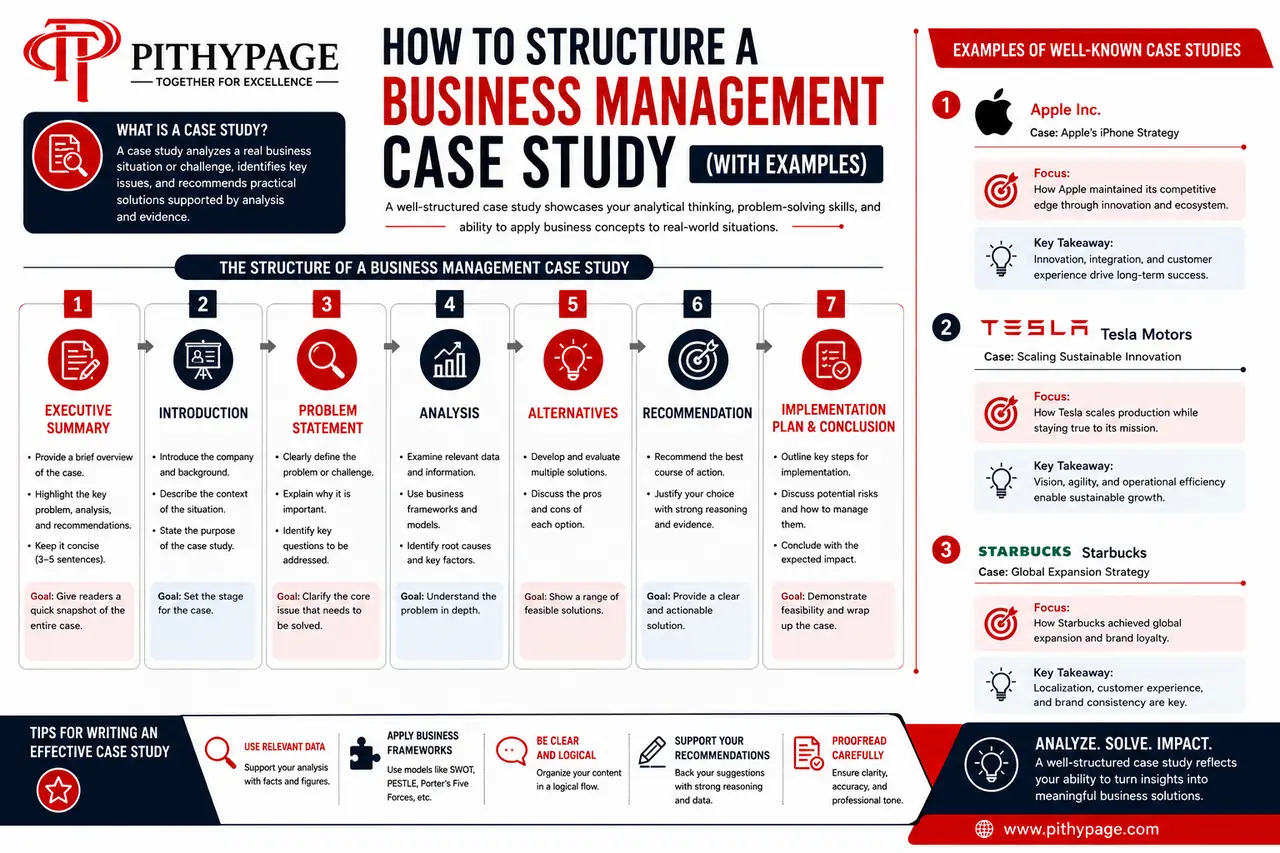
A business management case study is one of the most common assignment formats in business degrees – and one of the easiest to get wrong. Students often either summarise the company’s history (too descriptive) or jump straight to opinions (too thin on analysis). A strong business management case study structure sits between the two: it uses the case as evidence to support a clear, theory-backed argument.
Here’s a structure that works across most business management modules, along with the mistakes that most often cost marks.
1. Start With a Focused Introduction, Not a Company Profile
Resist the urge to open with a full company history. Markers already know the case; what they want is your framing of the problem. A strong introduction states the core issue in one or two sentences, names the management theory or framework you’ll apply, and previews your argument. Save company background for a single supporting sentence, not a paragraph.
2. Identify the Real Problem, Not the Obvious Symptom
Most case studies present a visible symptom – falling sales, high staff turnover, a failed product launch – but the mark-earning work is tracing that symptom back to its underlying management cause: a structural issue, a leadership gap, a flawed decision-making process, or a misaligned strategy. Spend real time here before you start writing. A case study that analyses the wrong problem, however well written, has a low ceiling on marks.
3. Apply a Named Framework Explicitly
This is where many students lose marks without realising it: describing a situation in plain English instead of applying a named model. If you’re analysing external factors, say so and use PESTLE. If it’s competitive positioning, use Porter’s Five Forces. If it’s organisational culture, name the specific model (Schein, Hofstede, or whichever your module teaches) and map the case evidence onto its actual components, not just its general idea.
- Name the framework explicitly in a subheading or topic sentence
- Map each part of the framework to specific evidence from the case, not general statements
- Note the framework’s limitations for this specific case – this signals critical thinking
4. Use Evidence From the Case, Not Assumptions
Every claim in your analysis should trace back to something stated in the case material – a figure, a quote, a described event – not to what you assume a company “probably” did. If the case doesn’t mention something, don’t invent it to fill a gap in your argument; instead, flag it as a limitation or make a clearly labelled assumption and justify why it’s reasonable.
5. Make Recommendations Specific and Feasible
“The company should improve communication” is not a recommendation a marker can credit highly – it’s too vague to evaluate. A strong recommendation names who should act, what specifically should change, and how it addresses the root problem you identified earlier, ideally with a nod to feasibility (cost, time, resistance to change). Two or three well-justified recommendations beat five generic ones.
6. Close With Judgement, Not Just Summary
A weak conclusion restates the introduction. A strong one makes a judgement call: which factor mattered most, what the company should prioritise first, and why. This is where you show you can weigh competing issues rather than just list them.
Frequently Asked Questions
How long should a business management case study be? Length depends entirely on your module brief, but most run 1,500-2,500 words at undergraduate level. What matters more than length is depth of analysis per issue – two well-analysed problems outperform five shallow ones.
Do I need to use more than one framework? Only if the case genuinely spans multiple areas (say, both external environment and internal culture). Using one framework well is stronger than using three superficially.
What’s the biggest mistake markers report seeing? Description without analysis – retelling what happened in the case rather than explaining why it happened and what it means using management theory.
Getting Feedback on Your Draft
If you’d like a second opinion on whether your framework is correctly applied or your recommendations are specific enough, a tutor can walk through your draft with you before submission. Our business management course help service pairs you with a mentor who reviews your structure and reasoning stage by stage, rather than just marking the finished draft. See our full range of academic tutoring services for related subjects.